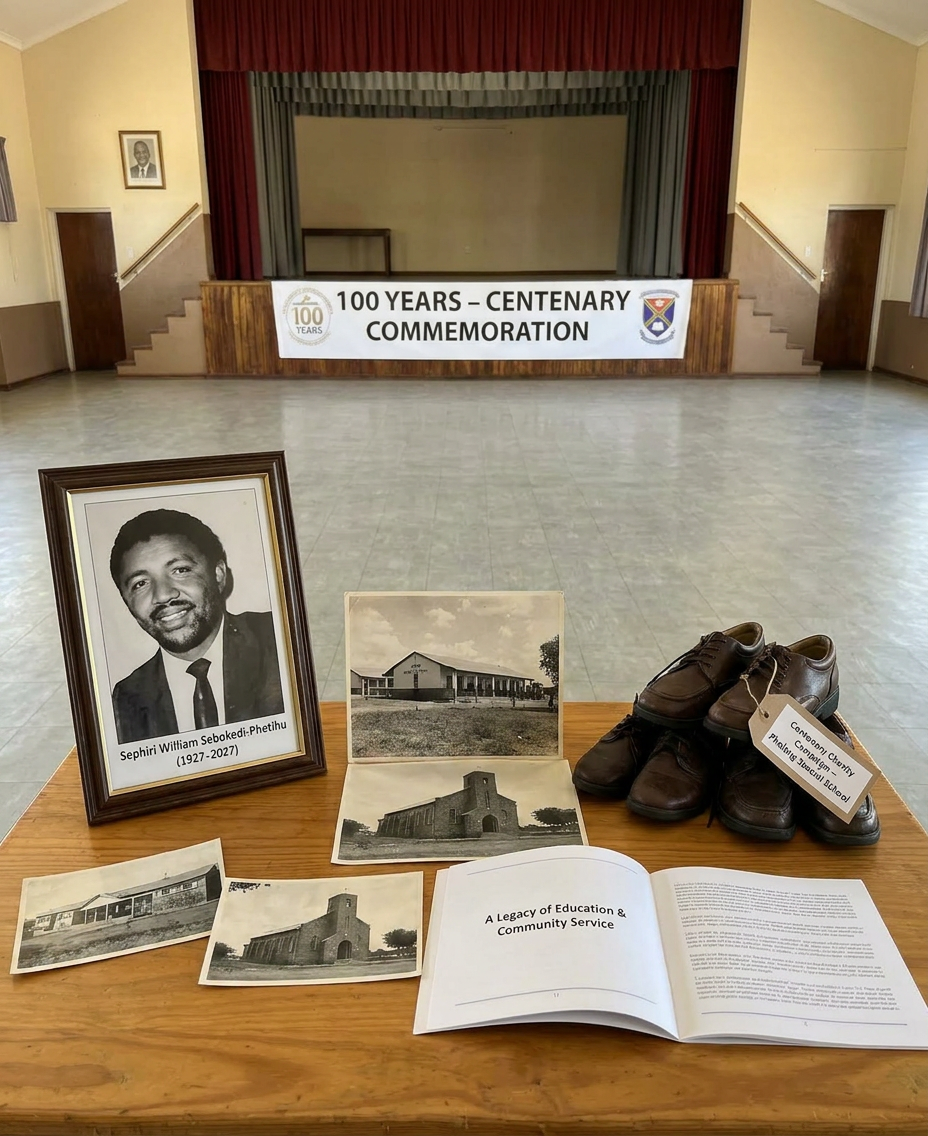
Sephiri William Sebokedi-Phetlhu (1927–2027) Centenary Commemoration
Up to this day, I still miss the willow trees that stood beside the tranquil stream in Daggafontein, near the mines in Springs. That quiet place was our childhood playground, shared with friends like David Kotsi and Malala Ledwaba. The serenity of the veld – flowing water, chirping birds, and the gentle rhythm of nature – formed the earliest soundtrack of our lives, soothing our young and curious minds.
That peace was suddenly interrupted one early morning in 1970 by the rumbling engines of Biddulphs International removal trucks. They had come to relocate our family from Springs to a new home in Temba, at the Bantu Investment Corporation (BIC) Business Centre – today known as the Tshwane North TVET College Temba Campus.
Perhaps what softened the transition was that the BIC estate stretched across 5 hectares, rich with birdlife and natural beauty that echoed the environment we had known in Daggafontein. It felt, in some ways, like a continuation of home.
Our move to Temba in early 1971 marked the first footprints of our family in that community. It followed my father’s appointment as the founding principal and manager of the BIC Business Centre. My late father, William Sephiri Sebokedi (3 March 1927 – 15 December 1990), would go on to play a catalytic role in the development of Babelegi Industrial Park and in supporting emerging entrepreneurs across Temba and the greater Hammanskraal area.
Had he lived to celebrate his centenary on 3 March 2027, he would have reflected with pride on a life devoted not only to his family but to the broader community. His contributions spanned business, education, social welfare, and the church.
Born on 3 March 1927 to Majang Sebokedi (circa 1900–1946) and Prince William Makgetla Phethlu (1907–1976) of the Barolong boo Ratshidi, his life journey was one of resilience. From humble beginnings shaped by poverty, he rose to become a self-made businessman and respected community leader. By lineage, he traced his roots to Chief Morolong, founder of the Barolong people, who reigned during the 15th century.
Although financial hardship denied him the opportunity to pursue higher education studies after completing his schooling at Kilnerton Missionary School in Pretoria, he never abandoned his belief in education. Instead, he made it his life’s mission to ensure that his children, grandchildren, and many others in the community had access to learning.
Amongst his many legacies, he was a founding member of Phelang Special School and PHL Moraka High School in Temba. He also served diligently on school governing bodies, including Ratshepo High School, from the 1970s until his passing in 1990 at the age of 63.
Many in the community remember “Bra Willy,” “Oom Willy,” or simply “Ntate Sebokedi” as the owner of Babelegi Restaurant in the Babelegi Industrial Park from 1973 to 1990. Yet beyond business, his greatest calling was service – to both community and faith.
Upon arriving in Temba, one of the first things he sought out was St John’s Anglican Church, then under the leadership of Reverend Manaswe. Over the years, he served faithfully as an Archdeacon and contributed to the growth of the church, including helping to fund the construction of its modern buildings in Temba, Hammanskraal.
One can almost imagine the moment of his birth on that early autumn day on 3 March 1927 -humble, unassuming, yet destined to mark the beginning of a generational journey. His life became the foundation upon which a century-long legacy would be built.
From his first son, Mokgweetsi Hampton “Jimmy” Sebokedi who was born on 1 November 1948, to the newest generation – twin boys Kagiso and Mohau, born in January 2026 – his legacy lives on in their genetic architecture. Above all, he broke the cycle of intergenerational poverty and ignorance, placing his family on a new path of education, dignity, and socio-economic advancement.
His passing left a profound void in both family and community. One memory remains especially vivid: on Christmas night in December 1993, as my late mother sat in the garage where he had collapsed, she found the strength to recount his final moments.
His last words were simple yet profound: “Bana ba tsene sekolo.” Let the children be provided an opportunity to gain knowledge through education. His enduring message was clear: There is no greater inheritance than education and knowledge.
As we commemorate 100 years since his birth in 1927, the legacy of Sephiri William Sebokedi-Phetlhu calls us to action. His life reminds us that true success lies not in accumulation, but in contribution; not in individual advancement, but in collective upliftment.
The centenary celebrations present a meaningful opportunity to honour this legacy through a renewed commitment to philanthropy in education. Through the Commemorative Centenary Charity Crowd Fundraising Campaign, we invite individuals, businesses, and institutions to contribute towards a focused and impactful cause: providing school shoes for learners at Phelang Special School.
For many learners, something as simple as a pair of school shoes can make a profound difference – restoring dignity, improving daily comfort, and enabling consistent school attendance. By supporting this initiative, donors will not only be meeting an immediate need, but also advancing educational access and inclusion for children with special needs.
This campaign reflects the very essence of Sephiri William Sebokedi-Phetlhu’s legacy – practical, community-driven philanthropy that responds directly to the lived realities of the people it serves. It is a continuation of his lifelong commitment to ensuring that no child is left behind due to circumstance.
In contributing to this cause, we do more than give – we invest in confidence, dignity, and the future of every learner supported through this initiative. Together, we can walk forward in his footsteps, ensuring that his vision of empowerment through education continues to shape generations to come.
In remembering Sephiri, we do more than reflect – we recommit. His legacy lives on in every learner empowered, every opportunity created, and every life transformed through education.
“Ke namane tsa tholo, Barolong,
Dijang mogope di a lala.
Ba ga mogogoro loso,
Ba ga gogomela.
Ba ga Morara-a-Noto, Barolong.”